
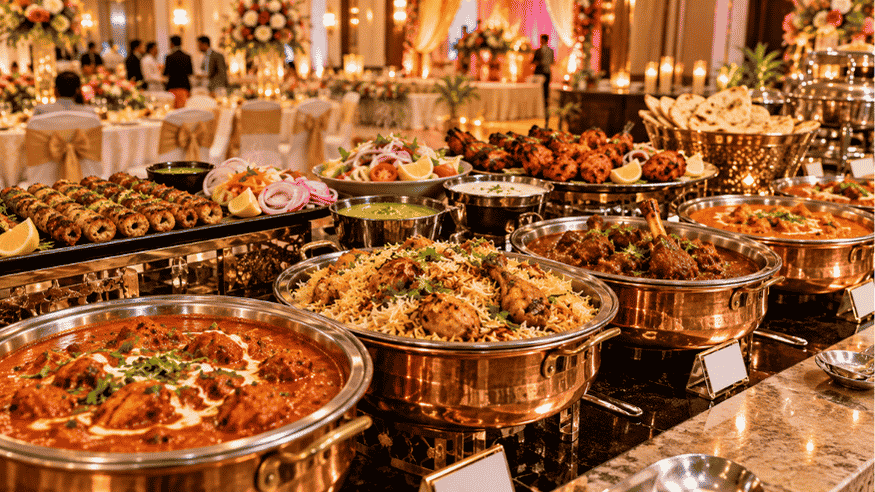
Ask any Indian family what guests remember after a wedding and the answer is usually the food. When the guest list includes non-veg lovers, the menu needs extra thought: which dishes, how many, and how much chicken or mutton to order without running short or wasting half of it.
This guide covers everything you need to plan a non-veg menu for a wedding, reception, sagai or big family party:
- What a complete menu looks like
- Dish ideas for every course
- Ready sample menus for 50, 100 and 250 guests
- A simple quantity-per-guest guide you can share with your caterer
Step 1: Know Your Veg and Non-Veg Split
In most families in Madhya Pradesh, a wedding crowd is mixed. Some guests eat non-veg, many don’t, and some avoid it on certain days. Before you plan anything:
- Ask on the RSVP. A simple “veg / non-veg” option on the WhatsApp invite gives you a real count instead of a guess.
- Check the day. If the function falls on a Tuesday, Thursday or Saturday, or during a fasting period, fewer guests may eat non-veg. Plan a smaller non-veg share.
- Keep the veg menu complete on its own. Vegetarian guests should have just as many starters and mains to choose from.
Separate counters matter. Ask your caterer for separate counters, serving spoons and clear labels for veg and non-veg dishes. Many guests care about this as much as the taste.
Step 2: Build the Menu Course by Course
A well-balanced non-veg menu for a wedding or reception usually follows this structure.
Welcome Drinks
Fresh lime soda, mocktails, jaljeera, or hot tomato or chicken soup for winter evenings.
Non-Veg Starters (pick 2–3)
- Tandoori Chicken: the classic, smoky and always finished first
- Chicken Tikka: boneless, so easy for guests to eat standing up
- Malai / Reshmi Kebab: mild and creamy, loved by children and elders
- Chicken Seekh Kebab or Mutton Seekh Kebab: spiced mince on skewers
- Fish Tikka or Amritsari Fish Fry: a lighter option
- Chilli Chicken or Chicken Lollipop: for the Indo-Chinese fans
Tip: Mix one tandoori starter, one kebab and one Chinese starter. That way there is something for every taste and the tandoor doesn’t become a bottleneck.
Live Counters (optional but popular)
- Live tandoor counter with kebabs and tikkas served hot off the fire
- Live kebab or tawa counter for seekh, galouti or tawa chicken
- Chinese counter with noodles, chilli chicken and manchurian
Live counters spread guests out, so there is less crowding at the main buffet.
Non-Veg Main Course (pick 1–2)
- Butter Chicken: the most requested curry at any function
- Kadhai Chicken: bolder, with capsicum and onion
- Mutton Rogan Josh or Mutton Handi: rich, slow-cooked, best with roti
- Bhuna Mutton or Keema: dry and spicy, great for winter weddings
- Egg Curry: a budget-friendly addition for large gatherings
Biryani
- Chicken Biryani or Mutton Biryani with raita. For many guests, biryani is the main dish, so don’t skip it.
Breads and Rice
Butter naan, tandoori roti, laccha paratha, jeera rice or plain rice.
Veg Dishes That Go With Non-Veg
Dal makhani, a paneer dish, one dry seasonal sabzi and a green salad. These keep the plate balanced, and vegetarian guests eat them too.
Desserts
Gulab jamun, gajar ka halwa (winter), rasmalai, kulfi or ice cream, and a paan counter to finish.
Step 3: Quantity per Guest (Planning Guide)
This is the question every family asks: how much chicken per person for a party? The figures below are common planning estimates for a full menu with 2–3 starters, 2 mains, biryani and dessert. Use them for budgeting, then let your caterer fine-tune them for your crowd.
All amounts are per non-veg guest unless marked otherwise.
- Non-veg starters (all varieties together): 150–200 g raw boneless chicken/fish, or about 5–6 pieces
- Chicken curry (main): 150–175 g raw chicken (with bone)
- Mutton curry (main): 125–150 g raw mutton
- Chicken or mutton biryani: 250–300 g cooked biryani per plate
- Plain or jeera rice: 60–75 g raw rice per guest (all guests)
- Breads: 2–3 rotis or naans per guest (all guests)
- Dal makhani: 100–125 ml per guest (all guests)
- Dessert: 2 pieces of sweet or 100 g halwa/ice cream (all guests)
When to increase quantities:
- If there is only one non-veg main, raise it by about 30%.
- For a late-night reception or a crowd of young people, add 10–15%.
- At winter weddings, guests usually eat more than in summer.
When to reduce quantities:
- At a lunch function or on a hot summer day
- When there are many live counters, since guests fill up at the counters before the main buffet
Sample Non-Veg Menus by Guest Count
Menu A: Intimate Function (about 50 guests)
Ideal for sagai, roka, tilak or a birthday dinner
- Welcome: Fresh lime soda, veg soup
- Starters: Chicken tikka, malai kebab, paneer tikka, crispy corn
- Main course: Butter chicken, dal makhani, paneer butter masala, mix veg
- Rice and breads: Jeera rice, butter naan, tandoori roti
- Dessert: Gulab jamun, ice cream
For 50 guests with about 25 eating non-veg, plan roughly 4–5 kg raw boneless chicken for the starters and about 5–5.5 kg chicken for the curry. Butter chicken is the only non-veg main here, so its quantity is raised by about 30%.
Menu B: Mid-Size Reception (about 100 guests)
- Welcome: Mocktails, tomato soup
- Starters: Tandoori chicken, mutton seekh kebab, chilli chicken, hara bhara kebab, paneer tikka
- Main course: Butter chicken, mutton rogan josh, dal makhani, kadhai paneer, seasonal veg
- Biryani: Chicken biryani with raita
- Rice and breads: Jeera rice, butter naan, laccha paratha, tandoori roti
- Dessert: Gajar ka halwa (winter) or rasmalai, kulfi
For 100 guests with about 50 eating non-veg, plan roughly 8–10 kg raw chicken and mutton mince for the starters, 7.5–9 kg chicken and 6–7.5 kg mutton for the two curries, and 12–15 kg cooked biryani.
Menu C: Grand Wedding (about 250 guests)
- Welcome: Two mocktails, jaljeera, soup counter
- Live counters: Tandoor (chicken tikka, seekh kebab, paneer tikka), Chinese (chilli chicken, veg noodles, manchurian)
- Starters on the move: Fish fry, malai kebab, veg spring rolls, dahi kebab
- Main course: Butter chicken, mutton handi, egg curry, dal makhani, shahi paneer, two seasonal vegetables
- Biryani: Mutton biryani + veg pulao
- Rice and breads: Steamed rice, butter naan, tandoori roti, missi roti
- Desserts: Gulab jamun, rasmalai, ice cream, paan counter
For 250 guests, ask your caterer to plan from your RSVP count, not the total guest list. A 40% non-veg share is a sensible starting point for mixed crowds.
Seven Tips to Get the Non-Veg Menu Right
- Do a menu tasting. Taste the butter chicken and biryani before you finalise anything. Every kitchen’s spice level is different.
- Fix the spice level for the crowd. Keep the main curries medium-spicy. Guests who like it hot can add green chutney.
- Boneless for starters, bone-in for curries. Boneless pieces are easier at a standing buffet, while bone-in gives curries more flavour.
- Time the food with the pheras. If the muhurat is late at night, start serving dinner early so guests aren’t waiting hungry. Our vivah muhurat dates for 2026–27 list helps you see which dates fall on weekends.
- Keep starters coming in rounds. Serving in small, hot batches beats one big tray that goes cold.
- Plan for drivers and staff. Count photographers, the band and drivers in your food numbers.
- Don’t waste leftovers. Arrange in advance to pack extra food for staff or to donate it.
Hosting the Function at Hotel Varun, Guna
At Hotel Varun on AB Road, every banquet is catered by the same kitchen behind our Mosaic restaurant, where guests come back for our chicken and mutton dishes. We plan veg and non-veg menus with you, in North Indian, Chinese and Continental styles, as a buffet or a served meal. Menu tasting is available on request.
- Orion: for 200–250 guests indoors, plus 80–100 outdoors. Ideal for weddings and receptions.
- Perseus: for 50–80 guests. Ideal for sagai, roka, tilak, birthdays and anniversaries.
- Private kitty lounge and room: for smaller groups. See our kitty party space.
- 40 rooms upstairs: for out-of-town relatives. View our rooms.
Explore our banquet halls and in-house catering, or read about the chicken, mutton and grills served at our restaurants. Planning a smaller celebration? See our guide to birthday and anniversary celebration venues in Guna, or the ring ceremony and pre-wedding functions guide.
Want a quote for your menu? Call or WhatsApp +91 94259 06777 with your date and guest count.
Frequently Asked Questions
How much chicken do I need for 100 people?
If about half the guests (50 people) eat non-veg, and chicken is the only non-veg item (starter + one curry), plan around 17–21 kg of raw chicken in total. Reduce it if mutton, fish or biryani are also on the menu.
How many non-veg starters should a wedding have?
Two to three non-veg starters are enough. Choose one tandoori, one kebab and one Indo-Chinese for variety.
Should we serve both chicken and mutton?
For a reception or wedding dinner, yes. Chicken suits most guests, and mutton makes the menu feel special. For a small function, one chicken curry plus chicken biryani works well.
Can veg and non-veg food be served at the same function?
Yes, and it is the norm in most Guna weddings. Ask for separate counters, utensils and clear labels so vegetarian guests are comfortable.
Is biryani a starter or a main course?
Biryani is served with the main course. Many guests treat it as their main dish, so plan 250–300 g cooked per non-veg plate.
Quantities in this guide are planning estimates. Your caterer will adjust them based on your final menu, timing and guest mix.